From Compliance to Confidence: Designing EM & APS in a Contamination Control Strategy (CCS) for Pharmaceutical Cleanrooms
Learn how EM and APS integration transforms CCS from a compliance checklist to a data-driven foundation of sterility assurance.


Article Overview
- Framing the Problem: Why regulators demand more than checklists — moving from compliance to operational confidence.
- Core Definitions: Understanding CCS, Environmental Monitoring (EM), and Aseptic Process Simulation (APS) and how they interrelate.
- Design Principles: The foundational rules for integrating EM and APS into a modern contamination control strategy.
- Environmental Monitoring (EM): What to monitor, how to design sampling strategies, continuous monitoring, alert/action limits, and data integrity.
- Aseptic Process Simulation (APS): Purpose, designing robust media fills, worst-case interventions, interpreting results, and regulatory expectations.
- Integration into CCS: How EM and APS connect within the larger contamination control framework to form a unified sterility assurance system.
- Technology Choices: Particle counters, viable air samplers, EM software, incubation systems, and digital dashboards for data integration.
- Validation & Lifecycle Management: Qualification of monitoring systems, APS lifecycle, and continuous CCS review.
- Common Pitfalls: The frequent mistakes in EM and APS design — and how to avoid them.
- Case Study Example: A practical scenario showing how the integration of EM and APS reduced deviations and stoppages.
- Culture & Training: Building governance, human factors, and a data-driven culture to strengthen CCS.
- Roadmap to Confidence: A stepwise journey from project stage to mature, optimised CCS.
- Conclusion: Why confidence — not just compliance — should be the ultimate goal in cleanroom sterility assurance.
Introduction — why “confidence” matters more than compliance
Regulatory boxes checked are necessary, but they’re not sufficient. In sterile manufacturing, the end objective is predictable, reproducible sterility assurance — not just passing audits. A modern Contamination Control Strategy (CCS) should therefore shift the organisation from episodic compliance to continuous confidence: structured, defensible, risk-based systems that detect trends early, support robust investigations, and enable decisions informed by data. Two pillars of this shift are Environmental Monitoring (EM) and Aseptic Process Simulation (APS), commonly referred to as media fills.
When designed and executed as part of an integrated CCS, EM, and APS, these tasks evolve from discrete tasks to proactive quality intelligence systems that materially reduce contamination risk and enhance product quality confidence.
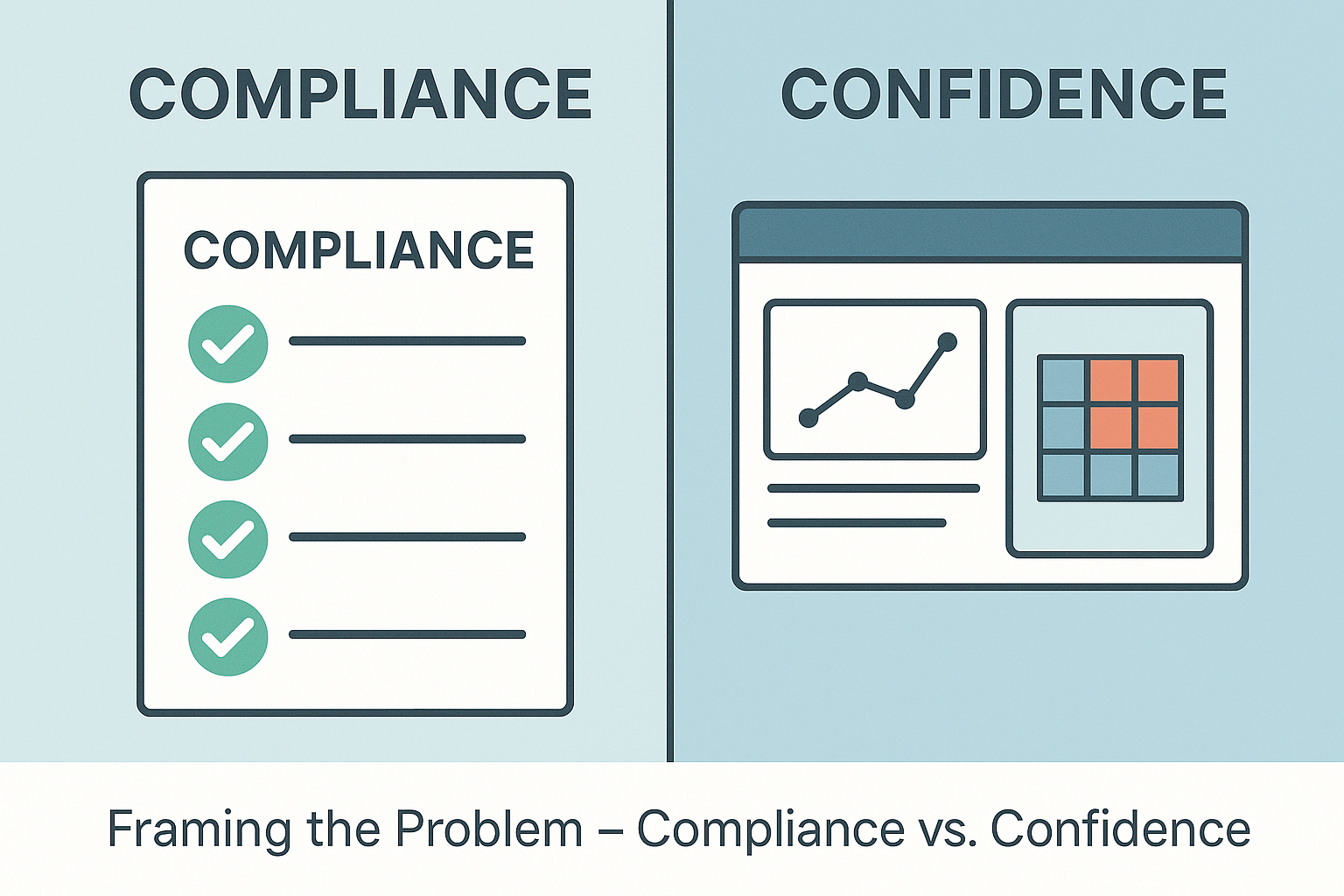
Framing the problem: what regulators expect and why it changed
Regulatory expectations since the Annex 1 rewrite (Aug 2022) and contemporary FDA guidance emphasise risk-based CCS, process knowledge, trending, and realistic challenge-testing of aseptic procedures.
Agencies now expect environmental data to be used for control decisions (not just filing), and APS (media fills) to simulate real worst-case operations and human interventions. These expectations push manufacturers away from “periodic sample collection” toward continuous, data-driven monitoring with documented decision criteria.
Key concepts: CCS, EM and APS — definitions and relationships
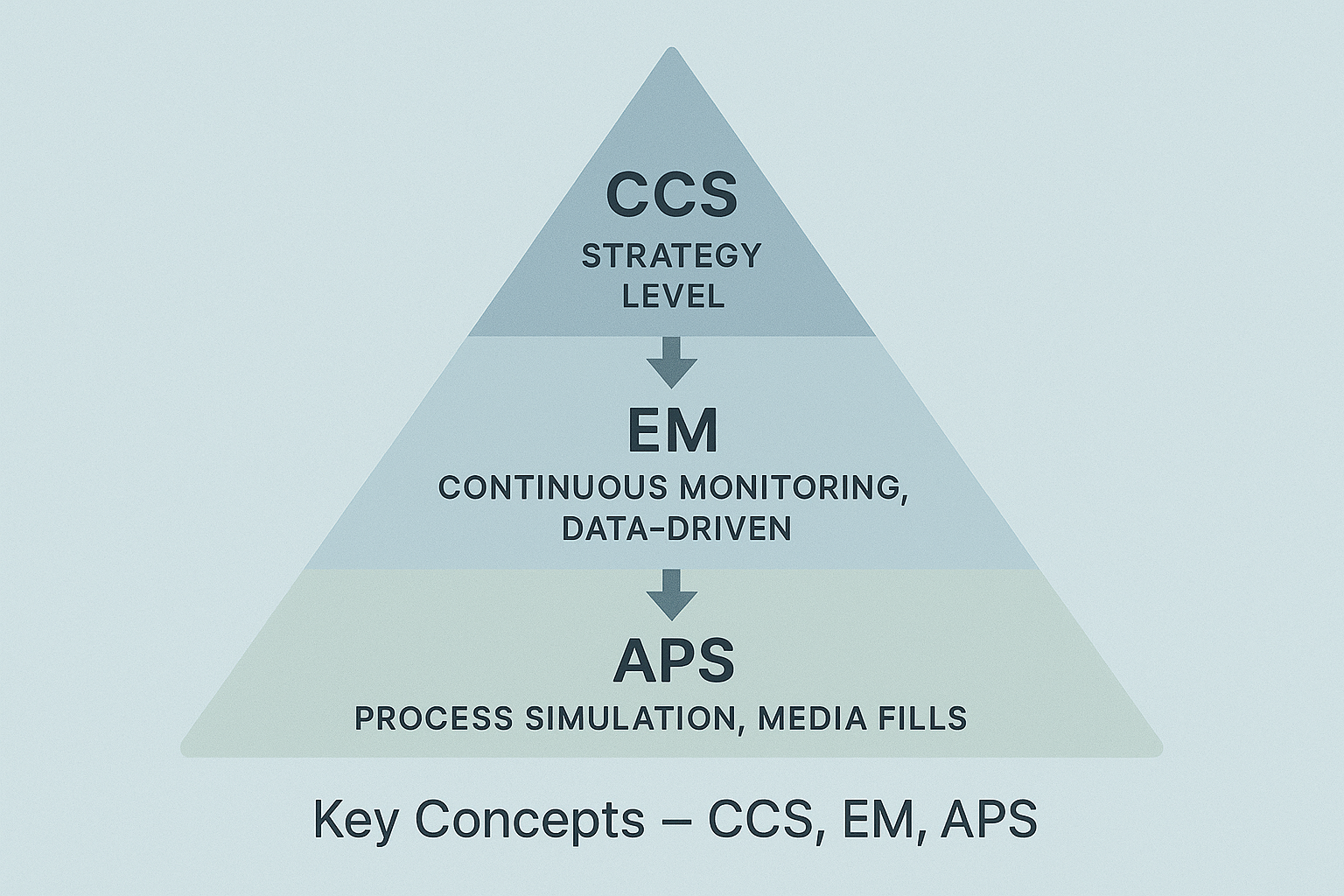
- Contamination Control Strategy (CCS): A documented, risk-based set of controls to manage particles, viable contamination, and endotoxin/pyrogens across facility, personnel, processes, and materials. CCS is the high-level roadmap that determines how EM and APS will be applied for a specific product-process combination.
- Environmental Monitoring (EM): Systematic sampling (viable and non-viable) of air, surfaces, water, and personnel to provide evidence that a controlled environment remains within established criteria. EM supports operational control, detection of emerging issues, and provides supporting data for investigations and CAPA.
- Aseptic Process Simulation (APS / media fill): A microbiological challenge test that uses growth media in place of product to evaluate the aseptic process, personnel performance, and equipment under routine and worst-case conditions. APS remains the primary tool for demonstrating process capability for aseptically filled sterile products.
Design principles for EM & APS inside a CCS
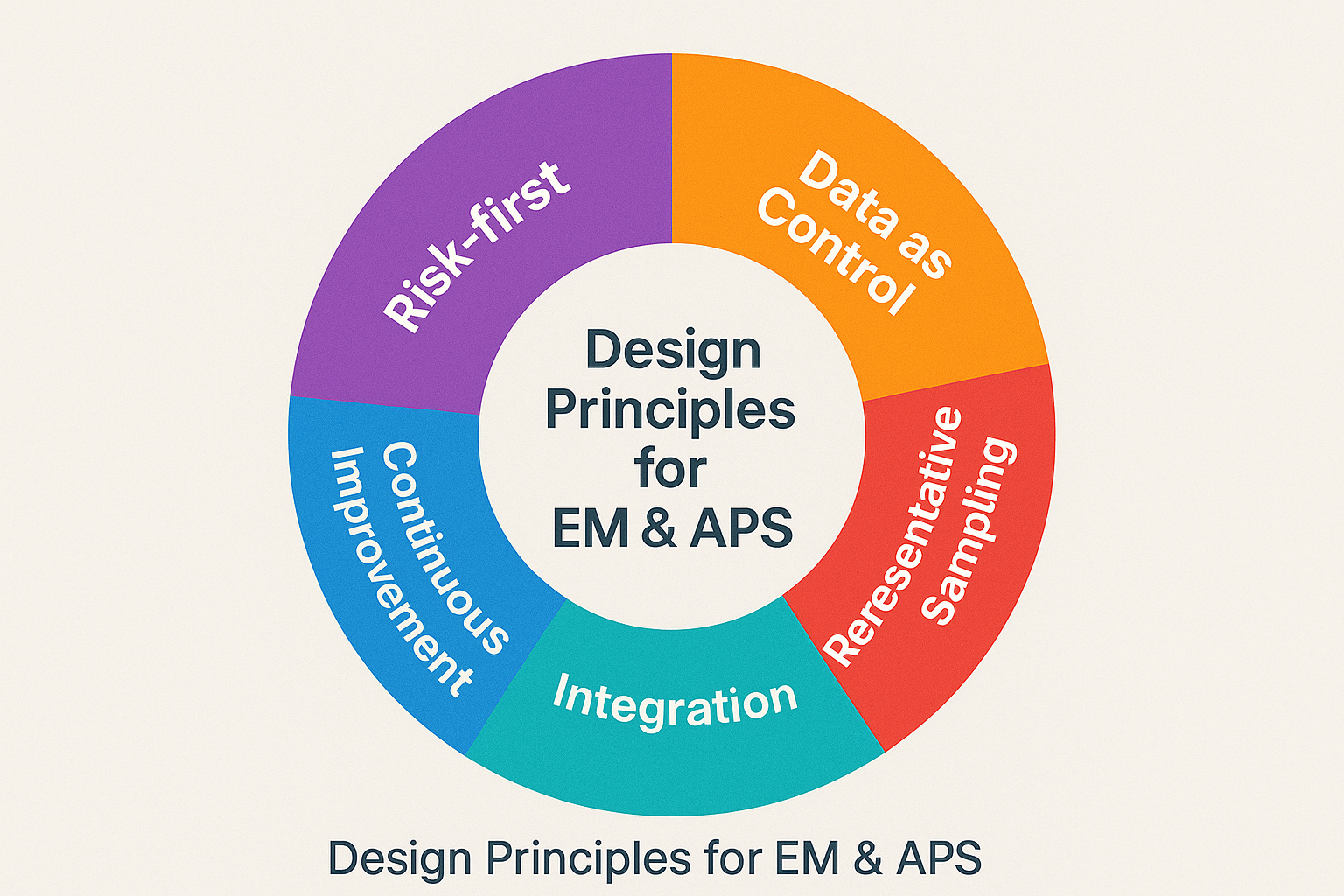
Design must be purposeful and risk-based. The following principles should guide every decision:
- Risk-first approach: Map product/process risks (sterility-critical steps, open manipulations, human interventions). Align EM sampling locations, frequency, and alert/action limits to what matters most for product quality. Regulatory guidance and industry best practice support risk-based monitoring plans.
- Data as control: EM is not just proof-of-performance. Use it for operational control (real-time alerts, trending, predictive triggers) and corrective actions.
- Representative sampling: EM must represent the worst-case exposures. For APS, simulate routine operations and define worst-case interventions (setup, stoppages, adjustments).
- Integration: Combine viable (microbial) and non-viable (particle) monitoring with process alarms, HVAC/FFU telemetry, personnel flows, and cleaning logs into a single ECS/CCS dashboard for correlation and root-cause work.
- Continuous improvement: Feed EM/APS outcomes into CAPA, training, and facility design updates.
Environmental Monitoring (EM) — technical design and practical details
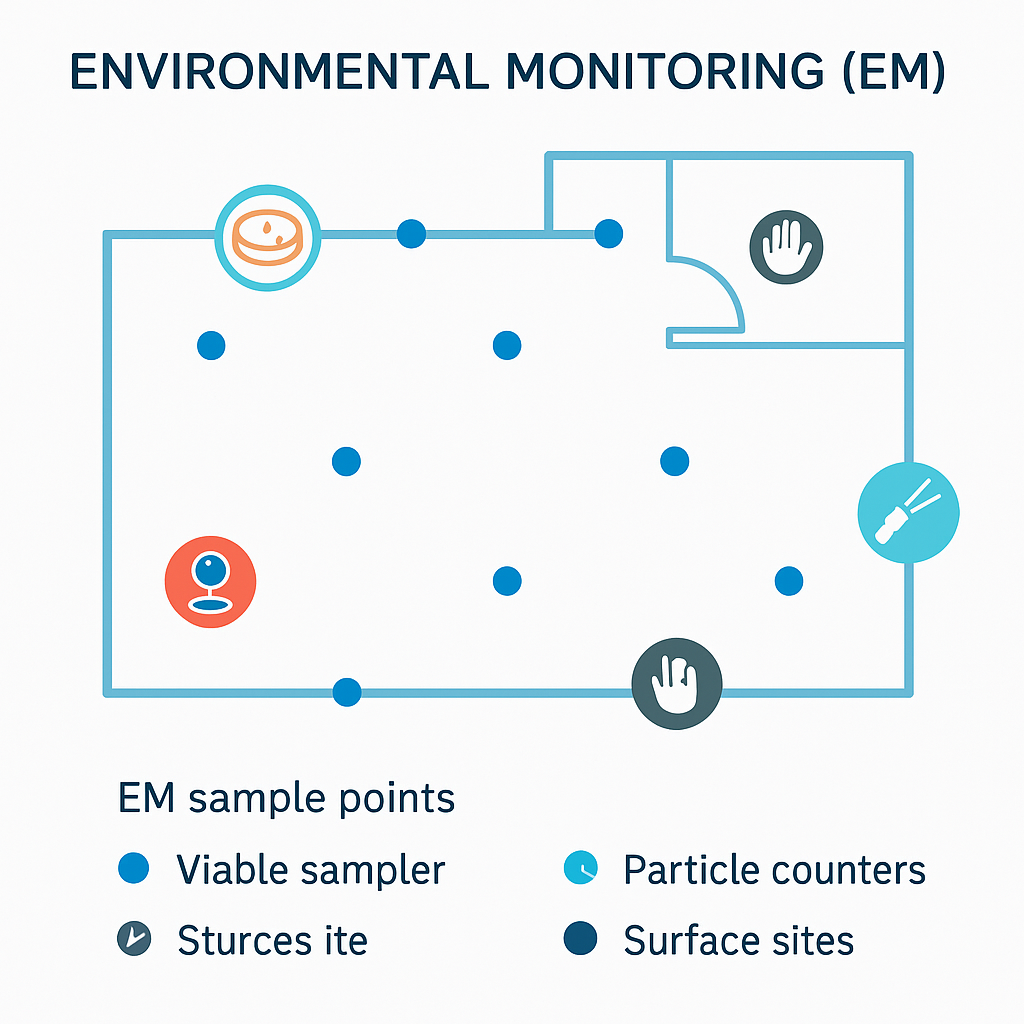
What to monitor
- Non-viable particles: Continuous or continuous+snapshot particle counting to demonstrate air cleanliness per ISO 14644-1 class, and to detect excursions related to equipment, personnel or maintenance events.
- Viable air sampling: Active air samplers (impaction, slit-to-agar) or settle plates where appropriate.
- Surface sampling: Contact plates, swabs, and rinse sampling for equipment, critical work surfaces, and aseptic tools.
- Personnel monitoring: Glove fingertip checks, gown monitoring, and monitoring during/after critical interventions.
- Water and utilities: Microbial counts and endotoxin testing for water-for-injection and other utilities.
Sampling strategy: location, frequency, and representativeness
Design a sampling map based on risk, with critical zones (Grade A/B in barrier isolators or open filling lines) requiring dense and frequent monitoring, and supporting areas requiring a proportionate approach. Key technical points:
- Place particle counters and viable samplers at representative critical points, such as near filling nozzles, first-door positions of isolators, and in locations that reflect operator reach and equipment openings.
- Frequency should be risk-informed, with more frequent monitoring during production and after any interventions. Baseline continuous monitoring is preferred where feasible to capture transient events.
Continuous monitoring: when and how
Continuous particle monitoring provides real-time insight into transient excursions that periodic sampling misses. Integrate continuous particle data with HVAC and FFU logs so alarms are meaningful (e.g., particle spike correlated with a maintenance door opening) and not nuisance alerts. Continuous, viable monitoring is still technically limited; therefore, it is combined with continuous non-viable monitoring and strategic viable sampling, along with trend-based rules.
Action and alert levels — setting meaningful thresholds
Action and alert limits should be set based on process knowledge and historical baseline data, rather than arbitrary numbers. The goal is early detection — an “alert” triggers investigation/trending; an “action” requires immediate containment. Document pre-defined investigative steps and escalation to CAPA.
Data integrity and trending
EM data systems must be validated, secure, and set up to enable trending (short-, medium-, and long-term). Trending frequency and review ownership should be part of the CCS (e.g., daily operational review, weekly trend review, quarterly deep-dive). Audit trails and access controls are mandatory.
Aseptic Process Simulation (APS / media fills) — design and execution
Purpose of APS
APS demonstrates that the aseptic process can produce sterile product reproducibly under routine and stress conditions. It evaluates:
- Ensure process robustness across routine and worst-case scenarios.
- Personnel technique and critical human error points.
- Performance of equipment and containment systems under real operating conditions.

Designing an APS program — technical checklist
- Define scope and acceptance criteria: the number of attempts, acceptable contamination rate (typically zero CFUs per unit, but the design must reflect regulator expectations and facility risk), and criteria for pass/fail with clear requalification paths.
- Worst-case scenarios: Include interventions expected during routine production (e.g., needle insertion, component change, machine adjustments). Annex 1 emphasises worst-case interventions and realistic simulation.
- Media selection and incubation: Use appropriate growth media for product contact simulations; incubate at conditions that will reveal contaminants (both temperature and duration per established protocols).
- Personnel and shifts: Conduct APS with operators performing their routine tasks to capture realistic human variability.
- Equipment state: APS must mimic worst-case equipment configurations (e.g., during warm-up, after maintenance).
- Sampling and monitoring during APS: Record viable and non-viable counts during the run, and include EM data correlation during any detected contamination.
Interpreting results and taking action
- Any growth in media fills is a sentinel event requiring immediate investigation, root cause, and CAPA. Use EM data, particle spikes, personnel logs, and CCTV to triangulate the cause.
- Requalification: define criteria and timelines for redoing APS after remediation.
Integrating EM & APS into the CCS — practical architecture
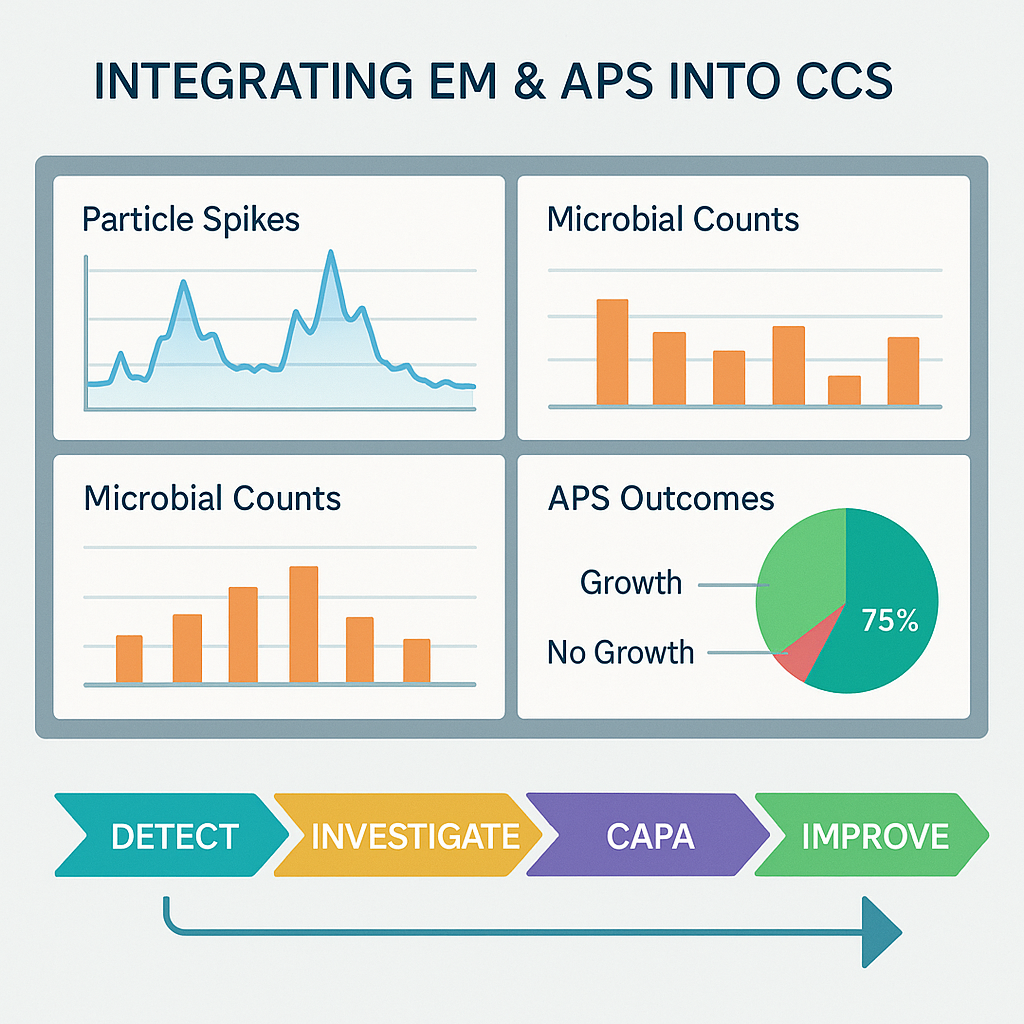
A CCS that links EM and APS should have three operational layers:
- Sensing and acquisition: Particle counters, viable samplers, door sensors, HVAC telemetry, and APC (access control) - all timestamped and synchronised.
- Platform and analytics: Centralised EM software (validated) that stores, visualises, and analyses data. Use rules-based alerts, automated trending, and basic predictive analytics to flag shifts before action limits are reached.
- Decision framework: SOPs that define who reviews which alerts, timelines for investigation, and when to escalate to quality and production stoppage.
Example workflow: particle spike → automated correlation with door/FFU logs → automated alert to production and QA → immediate area check and targeted viable sampling → decision logged and follow-up actions assigned.
Technology choices — pragmatic selection and validation
Continuous particle monitoring systems
Select industrial-grade, calibrated particle counters strategically deployed at key locations. Ensure redundancy and a validation plan covering sensor placement, alarm thresholds, and periodic recalibration.
Viable monitoring devices
Active air samplers remain the gold standard for viable air sampling. Select devices suitable for critical area sampling rates and integrate results into the EM software.
EM software platforms
Validated EM platforms should support:
- Centralised data storage with audit trails.
- Role-based access controls.
- Automated trending, report generation, and integration with MES/QMS.
- Ability to overlay EM data with APS results for investigations.
APS logistics
Media fills require strict microbiological controls, validated incubation, and chain-of-custody documentation for filled units and plates. Ensure lab capacity to incubate and read results within defined windows.
Validation, qualification, and lifecycle management
- Qualification: Validate and qualify monitoring equipment and software according to a documented protocol (IQ/OQ/PQ). Validate sampling locations and demonstrate representativeness.
- APS validation and protocol maintenance: APS protocols must be reviewed and updated periodically to reflect changes in processes, equipment, or personnel.
- Periodic review: CCS must be a living document. Regularly (annually or when process changes occur) review EM trends, APS outcomes, and corresponding risk assessments.
Common pitfalls and how to avoid them
- Treating EM as a checkbox: If EM isn't used for operational control and trending, opportunities to prevent contamination are missed. Embed EM review into daily operations.
- Poor sensor placement: Sensors placed for convenience (rather than representativeness) give false assurance. Use risk mapping to pick locations.
- Underspecified APS scenarios: APS that only simulate “happy path” operations will miss real-world risks. Include human interventions and stress conditions.
- Lack of data integration: Separate silos (particle counters, microbiology lab, HVAC) slow investigations. Integrate systems early.
- No ownership: Define clear responsibilities for EM review, APS execution, and CCS governance.
Case-study style example (high-level, anonymised)
A mid-sized sterile injectables site implemented continuous particle monitoring at filling nozzles and FFU returns, integrated with EM software, and expanded APS to include simulated interventions during line setup. Over the course of 12 months, they saw a 40% reduction in production stoppages caused by undiagnosed particulate excursions.
Real-time particle spikes allowed operators to pause and check before filling, and APS failures triggered targeted retraining, which in turn reduced subsequent personnel-related deviations. The key was linking particle spikes to operator logs and media fill outcomes — enabling a closed-loop CCS.
Building culture: training, governance and human factors
Technical systems are necessary but not sufficient. APS and EM depend on human performance. Build a culture where EM is respected as a leading indicator, APS results drive learning (not blame), and cross-functional teams (production, QA, microbiology, facilities) meet regularly to review trends and actions. Empower operators with clear SOPs and rapid feedback loops.
Practical roadmap — from project to steady state (high level)
- Assess: Map processes, risks, and current monitoring gaps.
- Design: Create a CCS blueprint aligning EM locations, continuous monitoring, APS scenarios, and decision rules.
- Pilot: Deploy limited continuous monitoring at critical points; run APS with current personnel and one worst-case scenario.
- Integrate: Implement EM software and link it to MES/QMS for alarm notifications and CAPA initiation.
- Scale & embed: Expand sensing coverage, formalise SOPs, and schedule periodic CCS reviews.
- Optimise: Use trend analytics and APS outcomes to refine sampling plans and reduce unnecessary sampling burden.
Conclusion — from compliance checklists to operational confidence
EM and APS are no longer isolated regulatory exercises; they are instruments of process knowledge. When designed as integrated elements of a risk-based CCS, they shift an organisation from reactive compliance to proactive confidence.
That confidence comes from representative sensing, realistic process simulation, validated analytics, and a quality culture that treats data as the primary control instrument. Build your CCS with clear ownership, strong data practices, and APS scenarios that mirror real life — and your sterile manufacturing will be defensible, resilient, and predictable.
References
- EU GMP Annex 1 — Manufacture of Sterile Medicinal Products (official text). Public Health
- FDA Guidance: Sterile Drug Products Produced by Aseptic Processing. U.S. Food and Drug Administration
- ISPE article: Validation of Aseptic Processes Using Media Fill. ISPE
- PDA / industry presentations on APS (media fill) best practice. Default
White papers and reviews on EM changes after Annex 1 (continuous monitoring). Particle Measuring Systems
My international experience as a researcher in Taiwan for three years has equipped me with a global perspective, enabling me to create content that resonates with an international audience.
More in Microbiology & CCS
All articles →
Active Air vs. Settle Plates vs. Contact Plates: Choosing the Right Environmental Monitoring Method

Setting EM Alert & Action Levels (Grades A–D): A Practical Guide for Pharma Professionals

Discussion